
How Did Our Collaboration With A Russian Cosmetics Brand, Worth 3 Million, Begin?
Who is the customer ?
Russia-a country historically renowned for its steel industry. With the transformation of the local economic structure, the client saw an opportunity and established a family-run cosmetics factory. The client didn't start in the beauty industry, but rather began by trading skincare and chemical raw materials. This experience gave them a deep understanding of formulations before building their product line. This foundation was crucial, as it shaped the client's approach to the brand: meticulous yet understated.
Prior to 2021, the client 's packaging told a different story. Amber-colored essential oil bottles, small cardboard boxes, and generic transparent containers-nothing conveyed the client's vision of a high-end brand. The gap between the brand's ambition and the reality of its packaging was obvious-and this gap was precisely the starting point of this collaboration.
The client 's brand philosophy is built on nature and authenticity. They own a lavender farm, and their formulas are centered around plant essential oils and pure ingredients. Their serums are priced at approximately RMB 300 per bottle in the local market, targeting female consumers aged 20 to 35. The client insists on using glass packaging because they believe the sense of quality conveyed by glass cannot be replaced by plastic or aluminum.
the customer place an initial order of 560,000 yuan without ever meeting them?
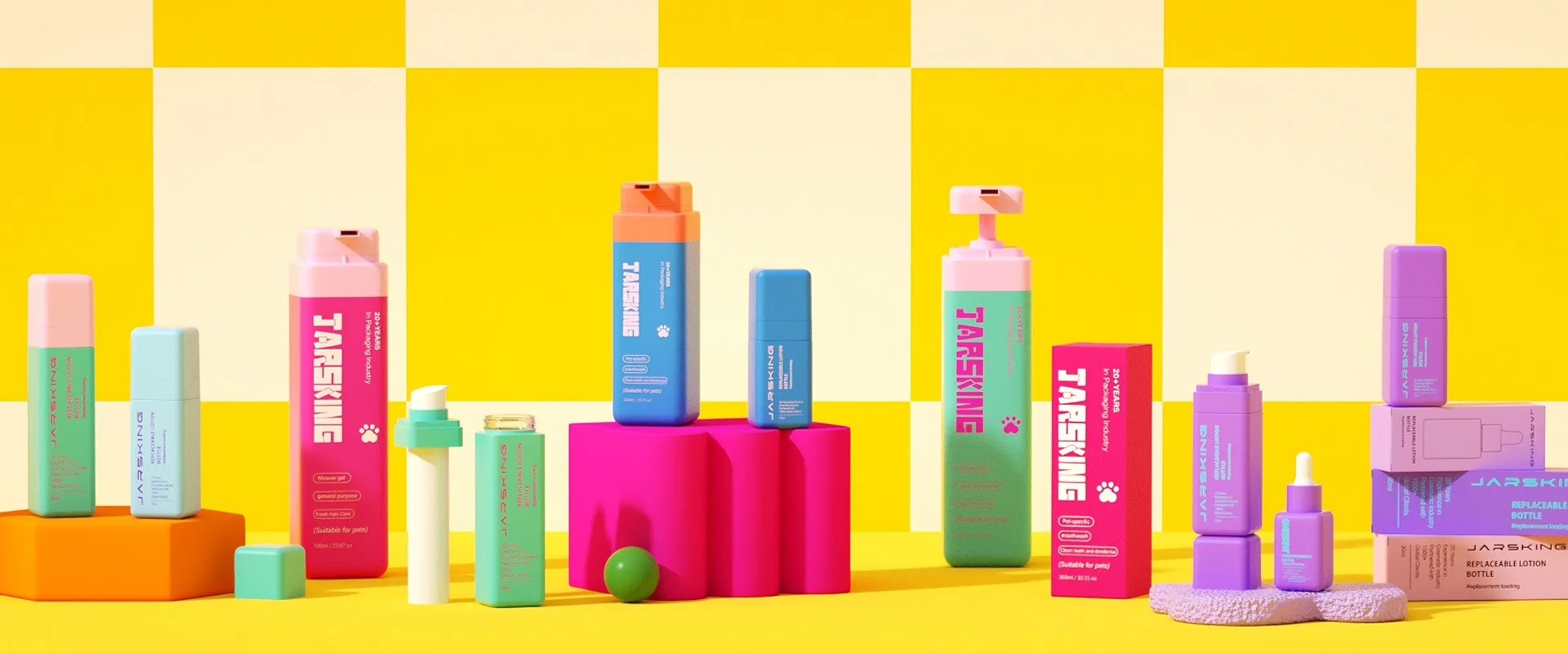
The product that opened the door was our rounded packaging series-a set with soft pink tones and a simple, modern design. The client immediately responded, "This is exactly what I want; I'll start designing around this."
The Straight & Round series sets cover six sizes: 30ml, 40ml, 50ml, 60ml, 100ml, and 120ml. For a brand owner building a product line from scratch, this complete size structure is extremely valuable-it means that every product in the line has a unified visual identity and belongs to the same family. This visual consistency is precisely the dividing line between a brand that "looks high-end" and one that "looks like a hodgepodge."
However, the process from initial interest to order confirmation is far more difficult: color grading development is completed under almost impossible conditions.
The client initially favored brighter, more saturated color tones-closer to the style preferred by customers in the African market. But that was 2021, during the pandemic. The client couldn't come to China, samples were difficult to ship internationally, and all color decisions had to be made online-one of the most difficult ways to confirm the actual packaging color. Our response was to spend a full week at the factory developing 12 color schemes, each with complete bottle samples covering all five sizes. Dozens of bottles were produced just for this color sample review.
The client rejected all colors in the first round.
We didn't treat this as a failure, but as information. The feedback pointed to a softer, more refined color palette. The second round explored macaron colors, which then evolved into Morandi tones-a low-saturation, sophisticated color scheme strongly associated with high-end skincare aesthetics. When the client saw the results of the second round, they immediately placed a full order: 560,000 RMB. Zero in-person contact, no factory visits, no handshakes, only video calls, meticulous sampling records, and a transparent collaboration process that built trust across 8,000 kilometers.

Four years of compound growth
That first order is a starting point, not an upper limit.
The first year's order was approximately 500,000 yuan for one container. It increased year by year, reaching 1 million yuan, and then exceeding that. By 2025, the client was ordering four to five containers annually, and the annual cooperation amount with this client had reached approximately 3 million yuan. This isn't just a story of one large order, but rather a story of a client's business continuously growing and its packaging needs increasing accordingly.
The number of SKUs clearly illustrates this growth curve. Early orders contained only a few products, but now each order typically includes 20 to 25 SKUs. The client currently operates approximately 100 offline retail stores, each requiring a different product mix. Their product line covers categories such as serums, lotions, body lotions, sunscreens, cleansing balms, facial cleansers, cleansing oils, and toners. We provide glass packaging, cardboard boxes , and related packaging materials for approximately 90% of the client 's SKUs ; only a small number of large aluminum containers and special outsourced components are not within our supply scope.
The partnership has also become more personal. We first met at a European trade show in 2023. That November, the client visited China. Since then, the client has visited our company four times-meeting at trade shows in Dubai and Europe, touring our factory, and establishing a working relationship that goes far beyond simply exchanging orders. This April, the client even brought gifts for our company leaders. This is no longer a transactional relationship, but a partnership.
Our client 's business footprint continues to expand-from Russia to Serbia, the United States, and beyond. Their printed packaging materials now display Russian, Serbian, and English text simultaneously. They had planned to establish a factory in Dubai, but this was later cancelled due to changing local circumstances. However, wherever their expansion takes them, their packaging infrastructure relies on us.
What exactly did we jointly establish?
Today, we are no longer just a packaging supplier , but a partner in product development.
We were deeply involved in product rendering, color development, structural optimization, and product line planning. Many colors in our client's brand have their own proprietary color formulas-color systems developed through dozens of rounds of prototyping and iteration, which cannot be easily replicated by a new factory. This color system is embedded in the client 's brand DNA and is one of the key reasons why this partnership has remained stable despite its ups and downs.
Our client 's commitment to sustainable packaging also shaped the content of our collaboration. They did not allow the use of foam materials in the inner packaging; all protective linings had to be kraft paper-based solutions. Their brand positioning revolved around biodegradability, recyclability, zero waste, and zero pollution-values that became particularly important as they continued to penetrate the European market. We developed customized outer packaging solutions for them , supported the development of all-PP bottle caps, and even shared some of the mold development costs. This kind of investment isn't something done for a transactional client; it happens when the relationship truly enters a strategic phase.

Four quality incidents: An honest post-mortem
First time: Rollerball dispensing malfunction
This is a newly launched skincare product with a roll-on applicator for applying serum to the eye area or other targeted areas. However, after the product arrived at the customer's location, the customer reported that the roll-on was not dispensing any product – no product was dispensed when the applicator was rolled.
Our initial reaction upon receiving the feedback was to suspect that the viscosity of the formula itself was too high, preventing the liquid from flowing through the ball bearing structure. This was a reasonable preliminary judgment, as ball bearing products have strict requirements for formula viscosity. However, after the customer sent photos and operation videos, the root cause of the problem became clear: it wasn't that the formula was too thick, but rather that the die-cut film inside the ball bearing assembly had not been properly opened during production. This film's function is to form a seal after assembly, and it should be cut or opened before normal shipment. However, this step was omitted in some products, causing the liquid to be unable to reach the ball bearing surface at all.
The solution to this problem is to replace the entire batch of ball bearing components, and at the same time conduct a systematic investigation and structural adjustment of products of the same model and related structures to ensure that similar problems do not recur.
Second: Bottle cap cracking – chemical reaction between materials and formula
This incident involved structural damage to the bottle caps. Customers reported that after a period of use, some product caps developed noticeable cracks or even broke.
On the surface, this could be due to insufficient cap wall thickness, problems with the injection molding process, or impact during transportation. However, upon closer analysis, the root cause is far more complex than the visible damage: a chemical reaction occurred between certain chemical components in the formula and the ABS plastic material used for the cap. While ABS material possesses good hardness and impact resistance under normal conditions, its tolerance to certain alcohols, esters, or high concentrations of active ingredients is limited. Prolonged exposure to these formulation components causes the ABS material to gradually soften, develop stress cracks, and ultimately crack.
The solution wasn't simply to replace the ABS cap with a thicker one, but rather to address structural adjustments based on material compatibility: the inner cap (the part that directly contacts the formula) was replaced with PP (polypropylene) – PP has stronger chemical resistance to most cosmetic formulas – while the outer cap remained ABS to maintain its original appearance, texture, and rigidity. This dual-layer design of "PP inside, ABS outside" solved the chemical reaction problem while maintaining the product's consistent appearance.
Key lesson learned: The selection of packaging materials cannot solely rely on appearance and cost; compatibility verification with the formulation is essential. This requires suppliers to proactively inquire about the core ingredient types in the formulation when undertaking new product development and to establish a basic material-formulation compatibility testing process. Following this incident, we added standard steps for material compatibility verification during the new product development phase.
Third time: The bottle neck broke.
Controlling the strength of glass packaging is one of the core challenges that glass bottle suppliers have long faced. This accident vividly illustrates this challenge.
Customers reported that some of the glass bottles they received experienced neck breakage during filling or use. The neck is the area of highest stress concentration in the glass bottle structure-whether it's the torque during capping, the clamping pressure during filling, or the impact of a drop, all of these factors can easily create stress concentration at the neck, leading to breakage.
Upon investigation, it was found that the neck wall thickness of this batch of bottles was below the reasonable standard. Some designs, in pursuit of a visually slender appearance, made the neck too thin, while the amount of glass used was not increased accordingly, resulting in insufficient actual structural strength.
The process involved three steps: First, a structural strength assessment of this design and similar products was conducted in conjunction with the glass manufacturer to determine the minimum safe wall thickness standard; second, mold parameters were adjusted to increase the amount of glass used and the wall thickness in the bottleneck area; finally, drop tests and torque tests were conducted to quantify the effectiveness of the improvements. Following these improvements, complaints about bottle neck breakage in subsequent batches significantly decreased.
Fourth : Bottle bottom cracks – a hidden risk due to inconsistent supply sources.
If the causes of the first four accidents were relatively clear, then the fifth one was more like a "hidden bomb"-it didn't appear in the previous batches, but suddenly exploded in a certain batch, catching everyone off guard.
The customer reported that some bottles in this batch developed bottom cracks during use. This differs from the neck breakage issue in the third incident-the bottle bottom is typically the thickest part of the glass bottle structure, and such problems are not common under normal circumstances. The customer naturally questioned: with the same design, why were there no issues before, but this time they're causing problems?
Following the investigation, the cause came to light: this batch of glass bottles did not originate entirely from the same source. Some came from our own partner glass factory, while others came from a second supplier who temporarily sourced the stock. Slight differences in the production process parameters between the two sources resulted in inconsistencies in the bottle bottom wall thickness and glass density. In this particular batch, the portion from the second supplier happened to have a slightly thinner wall than the design standard, leading to bottom cracking under the weight of the contents and the stress of thermal expansion and contraction.
There are two directions to solve this problem: one is to increase the bottom wall thickness in the design parameters to leave more safety margin for the structure; the other, more fundamental approach, is to strictly control the source of supply. For the same product and the same order, the supply must come from the same supply channel, and wall thickness should be randomly checked when receiving materials to ensure consistency of each batch.
Key lesson learned: Consistency in supply sources is a prerequisite for quality stability, not just a cost management issue. When a temporary substitution occurs at any stage of the supply chain, the corresponding quality verification process must be triggered; the assumption that "same specifications equals same quality" cannot be applied. This is especially important for products like glass packaging that are highly sensitive to process parameters.
customers stay ?
This is the really important question: After five major quality incidents, why is this customer still working with us, and why are their order volumes still increasing every year?
The reason clients stay isn't because their standards are low. It's because they made a rational judgment: the cost of switching suppliers-rebuilding the color system, reconfirming the structure, re-establishing the collaboration rhythm, and finding a factory willing to do the same level of development work-far outweighs the cost of dealing with problems through a responsible supplier. Client loyalty is never unconditional; it's won back after each problem is handled responsibly.
For a time, this collaboration was truly on the verge of collapse. After a series of after-sales issues accumulated, the client seriously considered changing suppliers, and a new supplier began prototyping. That supplier was connected to our supply chain, and ultimately, the prototyping did not proceed-partly due to this, but more fundamentally because the other party could not replicate the client 's exclusive color formula, nor could they replicate the complete packaging system we had jointly built. The risk was real, and it was mitigated, not by luck, but by the real switching costs accumulated over years of joint development.


