

How PPWR Is Changing The European Supply Chain
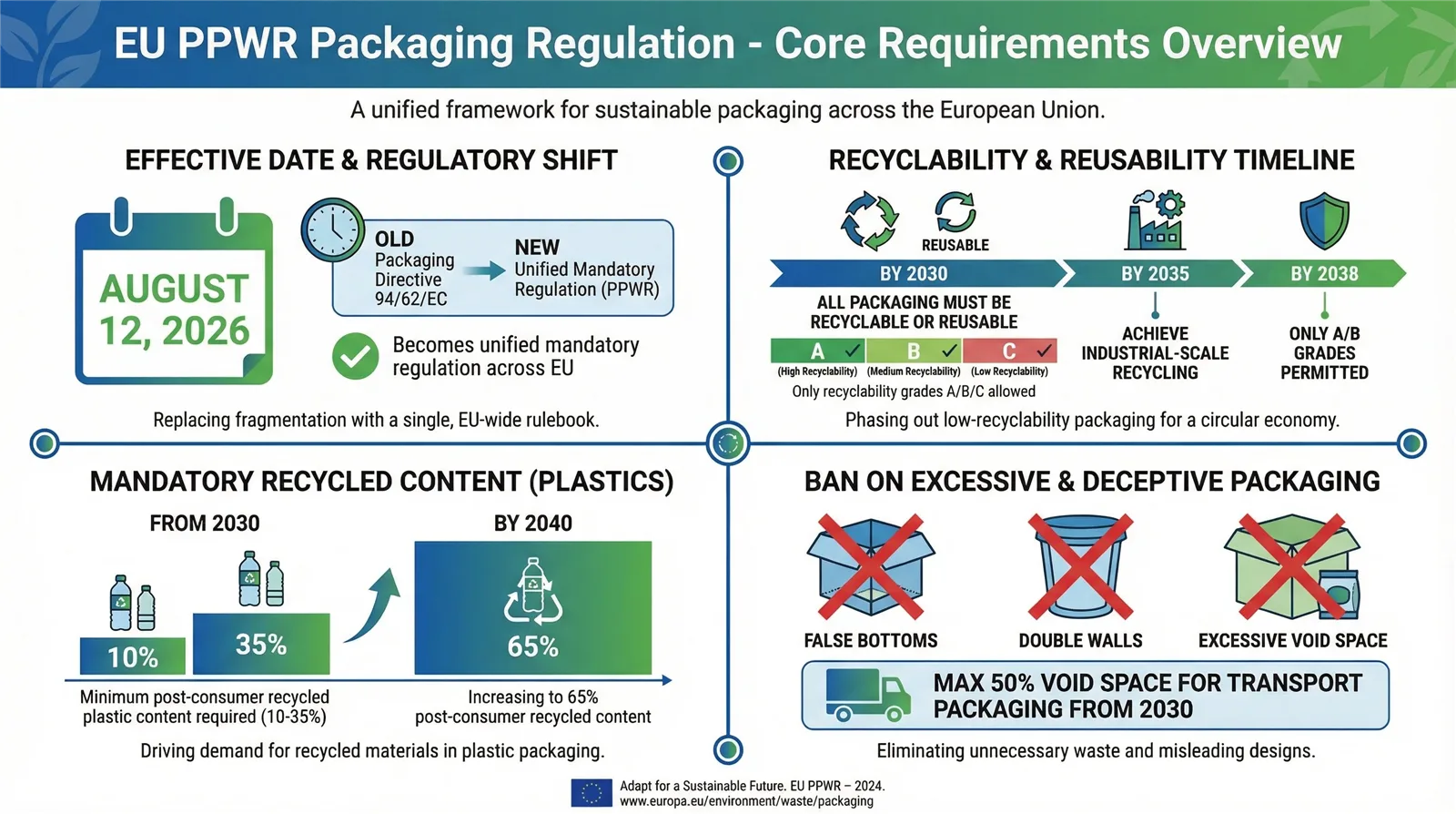
Europe stands at a critical juncture in its relationship with packaging. Each European now generates an average of 190 kilograms of packaging waste annually, representing a 6% increase from 2020 to 2021 alone, with projections showing nearly 20% growth by 2030 without decisive intervention. The regulatory response to this escalating crisis-the Packaging and Packaging Waste Regulation (PPWR)-represents far more than another piece of environmental legislation. Adopted in late 2024 and entering application in August 2026, PPWR fundamentally transforms how products are packaged, distributed, and consumed across the European Union, establishing a hard compliance deadline rather than aspirational sustainability goals that companies can comfortably ignore.
Unlike previous environmental directives that allowed flexible interpretation and gradual implementation, PPWR carries an unambiguous message: packaged goods that fail to meet sustainability criteria will not be allowed on the EU market. This creates an unprecedented forcing mechanism that compels companies across the entire packaging value chain-from raw material suppliers to brand owners and retailers-to fundamentally rethink their operations within an extremely compressed timeframe. For businesses accustomed to viewing sustainability as a marketing opportunity or corporate social responsibility initiative, PPWR represents a jarring wake-up call: sustainability has transitioned from optional enhancement to mandatory market access requirement.
Understanding PPWR
To appreciate PPWR's revolutionary impact, one must first understand what it replaces and why that replacement proved necessary. The previous framework, Directive 94/62/EC on packaging and packaging waste, served Europe for three decades but ultimately proved inadequate for addressing contemporary environmental challenges. Directives, by their nature, establish objectives that member states must achieve while allowing national governments to determine implementation methods. This flexibility, initially considered a strength, created a patchwork of inconsistent national regulations that complicated cross-border trade and allowed significant variation in enforcement rigor.
The packaging waste statistics from recent years demonstrate the directive's limitations. The 6% increase in per-capita packaging waste from 2020 to 2021-occurring during a global pandemic that temporarily disrupted consumption patterns-suggests accelerating rather than improving trends. Without decisive intervention, projections indicated nearly 20% growth by 2030, making Europe's circular economy and climate neutrality goals increasingly unattainable.
PPWR transforms this landscape by functioning as a regulation rather than a directive. This technical distinction carries enormous practical consequences. Regulations apply directly across all member states without requiring national implementing legislation, creating immediate legal obligations for businesses and uniform standards across the entire EU market. This harmonization eliminates the competitive distortions and compliance complexity that arose when different member states interpreted packaging requirements differently. More importantly, it establishes stronger enforcement mechanisms with meaningful penalties for non-compliance.
The regulation's core principles reflect evolved thinking about packaging sustainability. Rather than focusing narrowly on recycling-the traditional emphasis of waste policy-PPWR embraces the complete waste hierarchy, prioritizing prevention first, then reuse, and only finally recycling. This represents a fundamental philosophical shift from managing packaging waste after it's created to preventing unnecessary packaging from entering the market in the first place. The regulation deeply integrates circular economy principles, requiring that packaging be designed from inception for multiple life cycles rather than single-use disposal. It significantly strengthens Extended Producer Responsibility frameworks, making producers financially and operationally accountable for their packaging's entire life cycle. Finally, it mandates life-cycle thinking in packaging design, requiring consideration of environmental impacts from raw material extraction through end-of-life disposal.
PPWR Specific Regulations Overview
Substance Restrictions and Bans
|
Substance/Material |
Limit/Requirement |
Effective Date |
Details |
|
PFAS (per- and polyfluorinated alkyl substances) |
25 ppb per individual PFAS |
August 12, 2026 |
Banned in food contact packaging |
|
Heavy metals (lead, cadmium, mercury, hexavalent chromium) |
100 mg/kg maximum concentration |
Currently in effect |
May be lowered in future |
Recycled Content Requirements for Plastic Packaging
|
Packaging Type |
2030 Target |
2040 Target |
Details |
|
PET beverage bottles |
30% |
65% |
Post-consumer recycled content |
|
PET contact material packaging (non-beverage) |
30% |
Not specified |
Excludes beverage bottles |
|
Other plastic contact material packaging |
10% |
Not specified |
Plastics other than PET |
|
All other plastic packaging |
35% |
Not specified |
Packaging not mentioned above |
|
Average across all plastic packaging |
30% |
Higher targets |
Portfolio average for economic operators |
Reuse and Refill System Requirements
|
Packaging Category |
2030 Target |
2040 Target |
Effective Date |
|
Transport packaging (B2B between different companies/states) |
40% reusable |
70% reusable |
January 1, 2030 |
|
Transport packaging (B2B within same company/state) |
100% reusable |
100% reusable |
January 1, 2030 |
|
Beverage packaging (alcoholic and non-alcoholic) |
10% in reusable systems |
40% (aspirational) |
By 2030 |
|
HORECA sector takeaway |
Must offer consumer "bring your own container" option |
- |
2028 |
Deposit Return Scheme (DRS) Requirements
|
Container Type |
Collection Target |
Deadline |
Requirements |
|
Single-use plastic beverage bottles |
90% separate collection |
2029 |
Mandatory DRS by 2029 |
|
Metal beverage cans |
90% separate collection |
2029 |
Included in DRS requirement |
|
DRS system features |
- Non-profit independent operator |
2029 |
Exemption cancelled if <90% for 3 consecutive years |
Market Access Revolution: The Compliance Imperative
PPWR's most profound impact lies in its market access provisions, which fundamentally alter the business consequences of non-compliance. Under the previous directive regime, companies faced potential fines or regulatory censure for failing to meet sustainability targets, but could generally continue selling products while addressing compliance issues. PPWR eliminates this latitude: packaging that fails to meet regulatory requirements cannot legally be placed on the EU market, period.
This represents a hard deadline with no grace period or transitional flexibility. Starting August 2026, enforcement authorities gain clear legal grounds to prevent non-compliant products from reaching consumers, regardless of a company's good intentions, ongoing compliance efforts, or economic arguments about implementation challenges. For businesses accustomed to negotiating extended compliance timelines or implementing improvements gradually, this inflexibility requires radical adjustment in planning assumptions and risk management strategies.
The import and export dynamics shift dramatically under this framework. International companies manufacturing outside the EU but selling into European markets face identical requirements to EU-based producers, with no exceptions for third-country suppliers. This extends PPWR's effective reach globally, as major manufacturers often find it more practical to adopt EU standards worldwide rather than maintaining separate production lines and supply chains for European versus non-European markets. The regulation thereby influences packaging practices far beyond Europe's borders, establishing the EU as a global standard-setter whose regulatory choices ripple throughout international commerce.
Central to enforcement is the Declarations of Conformity (DOC) requirement, which shifts compliance verification from regulatory authorities to producers and distributors. Companies must proactively document that each piece of packaging meets all applicable PPWR requirements before placing it on the market, maintaining comprehensive records demonstrating compliance. This represents a fundamental change from voluntary reporting systems or periodic audits to continuous, comprehensive documentation obligations. The liability transfer is equally significant: producers and distributors bear legal responsibility for ensuring packaging compliance, with potential civil and criminal penalties for false declarations or inadequate verification systems.
Perhaps most significantly, PPWR eliminates what the industry has termed "perceived sustainability metrics"-vague, opinion-based claims about environmental friendliness that previously dominated packaging marketing. The regulation replaces these with fact-based "hard" requirements: specific recycled content percentages, measurable recyclability standards, quantifiable reusability targets. Claims about packaging sustainability must now be verifiable through objective documentation rather than subjective assessments or consumer perception research. This development effectively ends greenwashing in the packaging sector, as companies making environmental claims without substantiation face both regulatory penalties and civil liability for misleading consumers.
This transformation creates a sharply divided competitive landscape. Companies that act early to achieve compliance gain substantial first-mover advantages: they avoid market access interruptions, secure reliable sources of compliant materials before shortages drive prices higher, build consumer trust through demonstrated environmental leadership, and position themselves to capture market share from slower-moving competitors. Conversely, late movers face mounting risks: potential product recalls or market exclusion, inflated material costs as demand outstrips supply, reputational damage from being perceived as sustainability laggards, and lost market share to more responsive competitors. Brand reputation increasingly ties directly to compliance status, with consumers and business customers alike using PPWR adherence as a proxy for overall corporate responsibility and operational excellence.
Economic Impact: Costs, Investments, and Financial Pressures
The economic implications of PPWR compliance extend far beyond simple regulatory compliance costs, touching virtually every aspect of packaging-related business operations. Companies face rising operational costs across multiple dimensions simultaneously. Material costs increase as businesses transition from conventional substrates to compliant alternatives that meet recycled content, recyclability, and reusability requirements. Ecomodulation fees under Enhanced Extended Producer Responsibility schemes add variable costs based on packaging environmental performance. Research and development investments surge as companies develop new packaging solutions that satisfy both functional requirements and PPWR mandates. Testing and certification expenses multiply as each packaging format requires independent verification of compliance claims.
Supply chain cost dynamics prove particularly challenging and volatile. Sourcing adequate volumes of high-quality recycled materials meeting food-contact safety standards and technical performance specifications has emerged as a critical bottleneck. The secondary raw materials market experiences significant price volatility as demand from PPWR-driven requirements outpaces supply development, creating planning uncertainties for procurement teams accustomed to relatively stable packaging material costs. Competition intensifies for limited supplies of post-consumer recycled content, particularly in material streams where collection and processing infrastructure remains underdeveloped. Companies face strategic choices between securing long-term supply contracts at potentially unfavorable prices to guarantee material availability versus relying on spot markets that offer price flexibility but supply uncertainty.
Infrastructure and systems investments represent another substantial cost category that many companies initially underestimated. Digital tracking and reporting platforms capable of maintaining complete chain-of-custody documentation from raw material suppliers through manufacturing, distribution, and end-of-life become essential rather than optional. Quality control systems must verify recycled content authenticity and meet technical specifications across variable feedstocks. Supplier engagement and data collection tools enable systematic communication of data requirements and verification of supplier-provided information across multi-tier supply chains. Training and capacity building programs ensure that personnel throughout organizations understand PPWR requirements and their specific compliance responsibilities.
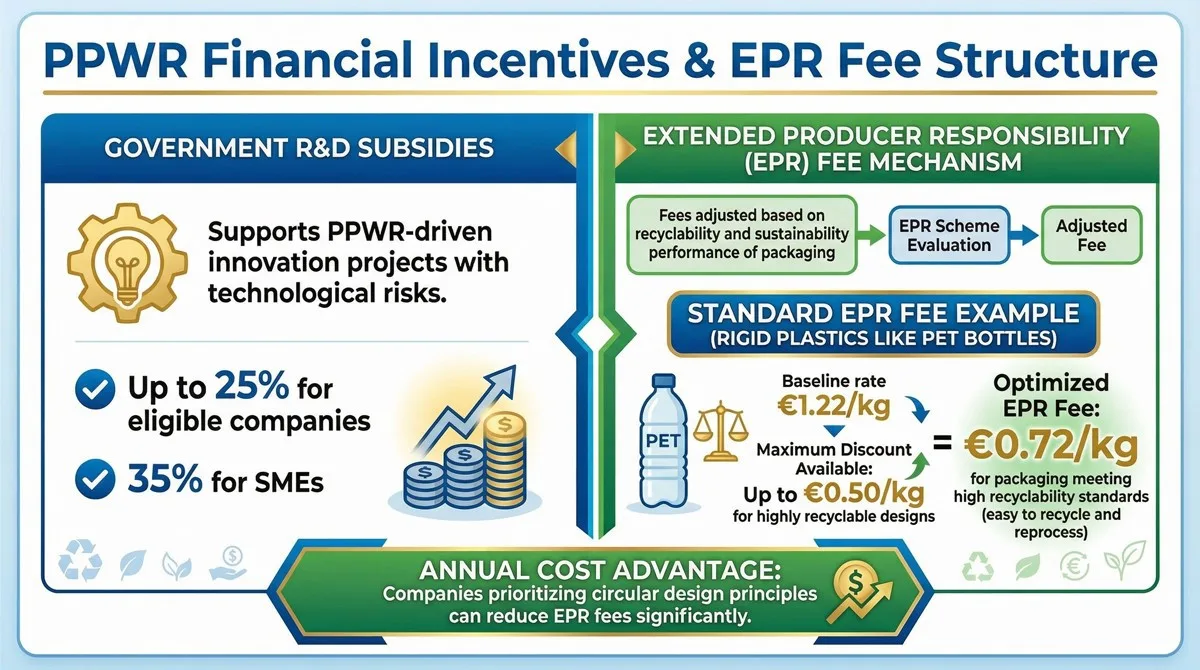
However, PPWR also creates financial incentives and support mechanisms that partially offset compliance costs for proactive companies. Government research and development allowances in various member states cover up to 25% of eligible expenses, rising to 35% for small and medium-sized enterprises, recognizing that PPWR-driven innovation projects involve technical risks and require developing novel solutions. Extended Producer Responsibility fee structures increasingly incorporate ecomodulation-adjusting fees based on packaging recyclability and sustainability performance. For example, rigid plastics like PET bottles with a regular tariff of €1.22 per kilogram can receive up to €0.50 in discounts, reducing effective costs to €0.72 per kilogram for highly recyclable designs that facilitate recovery and reprocessing. Companies focusing on circular design principles and ensuring packaging meets recyclability standards gain tangible competitive advantages through reduced EPR fees that compound annually.
The return on investment for compliance, when viewed strategically rather than as pure cost, can be substantial. Early action enables significant cost avoidance through multiple mechanisms: preventing penalties and fines for non-compliance that can reach substantial percentages of product revenue; securing preferential access to compliant materials before market shortages drive prices higher and availability lower; avoiding emergency redesign projects conducted under time pressure at premium costs; and preventing market access interruptions that damage customer relationships and brand equity. Additionally, circular design approaches often generate long-term cost savings by reducing material usage, simplifying manufacturing processes, and creating value from recovered materials that previously represented disposal costs.
Operational Transformation: New Systems and Processes
PPWR's operational requirements extend far beyond packaging design changes, demanding fundamental transformation in how companies manage information, coordinate with suppliers, and organize internal functions. Documentation and traceability requirements represent perhaps the most underestimated operational challenge. Companies must maintain comprehensive tracking from raw material extraction through manufacturing, distribution, retail, consumer use, and end-of-life management-essentially complete life-cycle documentation for every packaging component. Recyclability assessments must be conducted for each packaging format using standardized methodologies that evaluate technical recyclability, not merely theoretical recycling potential. Proof of recycled content requires rigorous chain of custody documentation demonstrating material flow from collection through sorting, reprocessing, and incorporation into new packaging. This data management infrastructure need frequently requires entirely new enterprise systems or substantial enhancements to existing platforms.
Supply chain restructuring emerges as an inevitable consequence of these requirements. Supplier qualification and audit processes must verify that upstream partners can provide necessary documentation and meet quality standards for recycled and sustainable materials. Data requirement communication protocols need systematic development to ensure suppliers at all tiers understand exactly what information companies need, in what format, with what verification, and on what timeline. Multi-tier supply chain visibility challenges intensify as companies realize they need transparency not just with direct suppliers but throughout complex global supply networks where raw materials may pass through numerous intermediaries before reaching final packaging manufacturers. This creates tensions between collaboration and competition, as companies must decide whether to work collectively on supply chain transparency initiatives or pursue proprietary advantages through superior supplier relationships and data systems.
The cross-functional organizational impact of PPWR touches virtually every business function, demanding unprecedented coordination and collaboration.
|
Department |
PPWR Compliance Responsibilities |
|
Procurement |
Develop expertise in sourcing recycled and recyclable materials; evaluate supplier sustainability claims; manage volatile secondary materials markets; balance cost, quality, and compliance considerations |
|
Research & Development |
Develop compliant packaging solutions maintaining product protection and brand appeal while meeting recycled content, recyclability, reusability, and weight minimization requirements-often involving fundamentally new material systems and structural designs |
|
Operations |
Implement new tracking systems; manage more complex material flows involving recycled content verification; coordinate with suppliers on data exchange; maintain quality control across variable feedstock |
|
Marketing |
Navigate increasingly complex labeling and environmental claims restrictions; develop consumer communication strategies around packaging changes; leverage sustainability credentials for competitive advantage while avoiding greenwashing accusations |
|
Legal |
Manage compliance risk and liability from Declarations of Conformity; negotiate contractual terms with suppliers regarding data provision and compliance warranties; handle intellectual property considerations around innovative packaging solutions |
|
Finance |
Budget for substantial compliance investments; evaluate make-versus-buy decisions for packaging capabilities; assess risks from non-compliance; identify opportunities for sustainability-linked financing |
Technology enablement proves essential for managing this complexity at scale. Digital packaging management systems provide centralized platforms for documenting packaging specifications, tracking regulatory requirements, managing compliance assessments, and generating required reports and declarations. Blockchain and distributed ledger technologies offer promising solutions for creating immutable chain-of-custody records that track materials through complex multi-party supply chains, though implementation challenges and cost considerations have limited widespread adoption to date. QR codes and other consumer-facing information technologies must be implemented to meet labeling requirements and provide transparency about packaging materials, recyclability, and disposal instructions. Data analytics platforms help companies monitor compliance status across large product portfolios, identify high-risk packaging formats requiring priority attention, and optimize material choices and design decisions for both compliance and cost-effectiveness.
Specific PPWR Requirements and Deadlines
Understanding PPWR's detailed requirements proves essential for effective compliance planning, as the regulation establishes a cascading series of obligations with varying timelines. The August 2026 immediate priorities include several critical mandates. The ban on intentionally added PFAS (per- and polyfluoroalkyl substances) in food contact packaging takes effect, requiring companies to verify that paper-based food packaging, fast-food containers, and other applications historically using PFAS for grease and water resistance employ alternative barrier technologies. Initial Declarations of Conformity must be prepared and maintained for all packaging placed on the market, documenting compliance with applicable requirements. Labeling harmonization compliance begins, requiring standardized information about packaging materials, recyclability, and disposal across all member states.
Recycled content mandates establish increasingly stringent targets over time. By 2030, plastic packaging must contain specified minimum percentages of post-consumer recycled content, with specific targets varying by polymer type and application. These targets recognize different technical challenges and recycling infrastructure maturity across material streams-for example, PET beverage bottles face higher recycled content requirements than complex multi-layer films where recycling technologies remain less developed. By 2040, the regulation escalates these requirements substantially, approaching levels that will necessitate near-comprehensive collection and recycling infrastructure for plastic packaging. Sector-specific variations acknowledge different risk profiles between food-contact applications requiring stringent safety verification and non-food-contact uses where recycled content incorporation faces fewer technical barriers.
Weight and volume restrictions address packaging minimization through requirements that packaging be limited to the minimum amount necessary to ensure product safety, hygiene, and consumer acceptance. This prevention-focused approach targets over-packaging practices common in various sectors, particularly e-commerce where large boxes for small items, excessive void fill, and unnecessary secondary packaging have proliferated. Right-sizing requirements increasingly mandate that packaging dimensions closely correspond to product dimensions, eliminating wasteful empty space that serves primarily visual or handling convenience purposes rather than genuine protective functions.
Reuse and refill systems receive particular emphasis as higher-order waste management approaches. Deposit-return system obligations require beverage container programs in all member states, ensuring high collection rates for single-use bottles and cans through financial incentives for consumer returns. Reusable packaging mandates apply to specific sectors including restaurant takeaway, fast-food service, and certain transport packaging, requiring businesses to offer reusable alternatives and establish systems for collection, cleaning, and redistribution. Infrastructure requirements for collection necessitate convenient return points, standardized container designs that facilitate reuse across different brands, and hygiene protocols ensuring consumer safety.
Packaging format restrictions phase out or prohibit certain categories entirely. Single-use plastic bans extend beyond bags and straws to include hotel toiletry bottles, certain food service items, and unnecessary secondary packaging. Material substitution requirements push companies away from problematic materials like PVC, polystyrene, and oxo-degradable plastics toward more readily recyclable alternatives or genuinely compostable materials for appropriate applications.
Design for recyclability establishes technical criteria defining when packaging can legitimately be labeled recyclable. These criteria consider sortability in existing waste management infrastructure, compatibility with established recycling processes, market demand for resulting recycled materials, and proven recyclability at scale rather than merely laboratory demonstrations. The regulation mandates elimination of problematic materials and combinations including certain adhesives that contaminate recycling streams, incompatible polymer blends, and decorative elements using materials that interfere with sorting or processing. Standardization initiatives aim to reduce the proliferation of packaging formats, colors, and material combinations that complicate sorting and recycling, moving toward more uniform systems that enable efficient material recovery.

Environmental and Sustainability Impacts
While much attention focuses on PPWR's business implications, the regulation's ultimate justification lies in its environmental and sustainability objectives. Waste reduction targets directly address the 190 kilograms per capita packaging waste Europeans generate annually, aiming for substantial absolute reductions by 2030 and 2040 even as economic activity and consumption continue growing. The regulation's emphasis on prevention over recycling reflects recognition that even perfectly circular recycling systems involve energy consumption, water usage, emissions, and material quality degradation-making waste prevention inherently superior from life-cycle environmental perspectives.
Climate change mitigation benefits emerge through multiple pathways. Reduced packaging volumes directly decrease greenhouse gas emissions from material production, which constitutes the largest carbon footprint component for most packaging. Carbon savings from increased recycled content use prove substantial, as producing materials from recycled feedstock typically requires far less energy than virgin production-for aluminum roughly 95% less, for plastics 70-80% less, and for paper 40-60% less depending on material and processing details. Life-cycle emissions comparisons increasingly favor lightweight, recyclable designs over conventional packaging, though results vary significantly depending on functional requirements, distribution distances, and waste management infrastructure quality.
Resource conservation extends beyond climate impacts to encompass broader natural resource preservation. Water use reductions result from decreased reliance on virgin materials, particularly important for paper and board packaging where pulp production consumes enormous water quantities. Energy savings through circular material flows compound over multiple recycling cycles, reducing fossil fuel consumption and associated environmental impacts. Virgin material extraction decreases as recycled content displaces primary materials, reducing mining, forestry, and petroleum extraction with their attendant environmental disruptions including habitat destruction, water pollution, and landscape alteration.
Circular economy acceleration represents PPWR's fundamental long-term objective. The regulation aims to close material loops at scale, ensuring that packaging materials remain in productive use through multiple cycles rather than degrading to waste after single use. This requires developing robust markets for recycled materials where quality standards, pricing mechanisms, and supply reliability enable recycled content to compete effectively with virgin alternatives. The regulation also stimulates innovation in bio-based and alternative materials as companies seek solutions that combine functionality, sustainability, and cost-effectiveness, though careful life-cycle assessment remains essential to ensure that novel materials genuinely offer environmental improvements rather than merely shifting impacts to different categories.
Broader environmental benefits extend throughout ecosystems and human communities. Reduced marine and terrestrial pollution results as prevention and circularity decrease packaging leakage into natural environments where accumulation causes extensive ecological damage. Decreased microplastic generation emerges as larger plastic items break down less frequently into the minute particles increasingly recognized as pervasive environmental contaminants. Protection of ecosystems and biodiversity follows from reduced material extraction and waste accumulation, preserving habitats and natural systems. Human health impact prevention encompasses reduced exposure to packaging-related chemicals, decreased pollution affecting air and water quality, and eliminated toxics in packaging materials that may migrate into products or contaminate recycling streams.
Industry-Specific Impacts
PPWR's requirements play out differently across sectors, each facing unique technical challenges and compliance considerations. The healthcare sector confronts particularly complex tensions between sterility and safety requirements versus sustainability objectives. Medical device packaging must guarantee sterility through distribution, storage, and handling while enabling sterile presentation during procedures-requirements historically met through single-use plastics and multi-layer barrier materials. Pharmaceutical packaging faces similar challenges balancing moisture barriers, light protection, and tamper evidence with recyclability and recycled content requirements, particularly for drug formulations requiring high protection levels. The regulation includes limited exemptions recognizing patient safety primacy, but healthcare organizations nonetheless face pressure to minimize packaging, adopt recyclable materials where feasible, and develop take-back systems for complex packaging that cannot enter conventional recycling streams.
Food and beverage sectors navigate food safety considerations that constrain recycled content use in direct food contact applications. Rigorous safety assessments must verify that contaminants from recycled materials cannot migrate into food products at levels posing health risks, requiring sophisticated analytical methods and conservative safety margins. Beverage container deposit systems become mandatory, requiring producers and retailers to establish collection infrastructure, handle returned containers, and coordinate with recycling systems-significant operational undertakings especially for smaller companies. Fresh produce packaging innovations seek solutions that maintain shelf life and reduce food waste while meeting PPWR requirements, a challenging balance given that inadequate packaging causing food spoilage typically generates far greater environmental impacts than the packaging itself.
E-commerce and retail face right-sizing and fit-for-purpose requirements that directly challenge common practices. Oversized boxes for small items, excessive protective materials, and multiple layers of branded packaging must give way to optimized solutions using minimum material. Returns management implications prove substantial, as businesses must design packaging that protects products through both initial shipment and potential return journey while remaining recyclable. Multi-channel packaging strategies must satisfy both e-commerce shipping requirements and traditional retail presentation needs, potentially requiring different packaging approaches for different distribution channels.
Automotive and industrial sectors address component packaging and transport packaging throughout complex global supply chains. Reusable container systems offer substantial environmental and economic advantages for regular shipment routes between established partners, with some automotive manufacturers reporting over 100 reuse cycles for standardized transport packaging. Supply chain logistics require coordination across multiple parties to ensure empty container return, cleaning, and redistribution-simpler in automotive's relatively concentrated supply networks than in more fragmented industries.